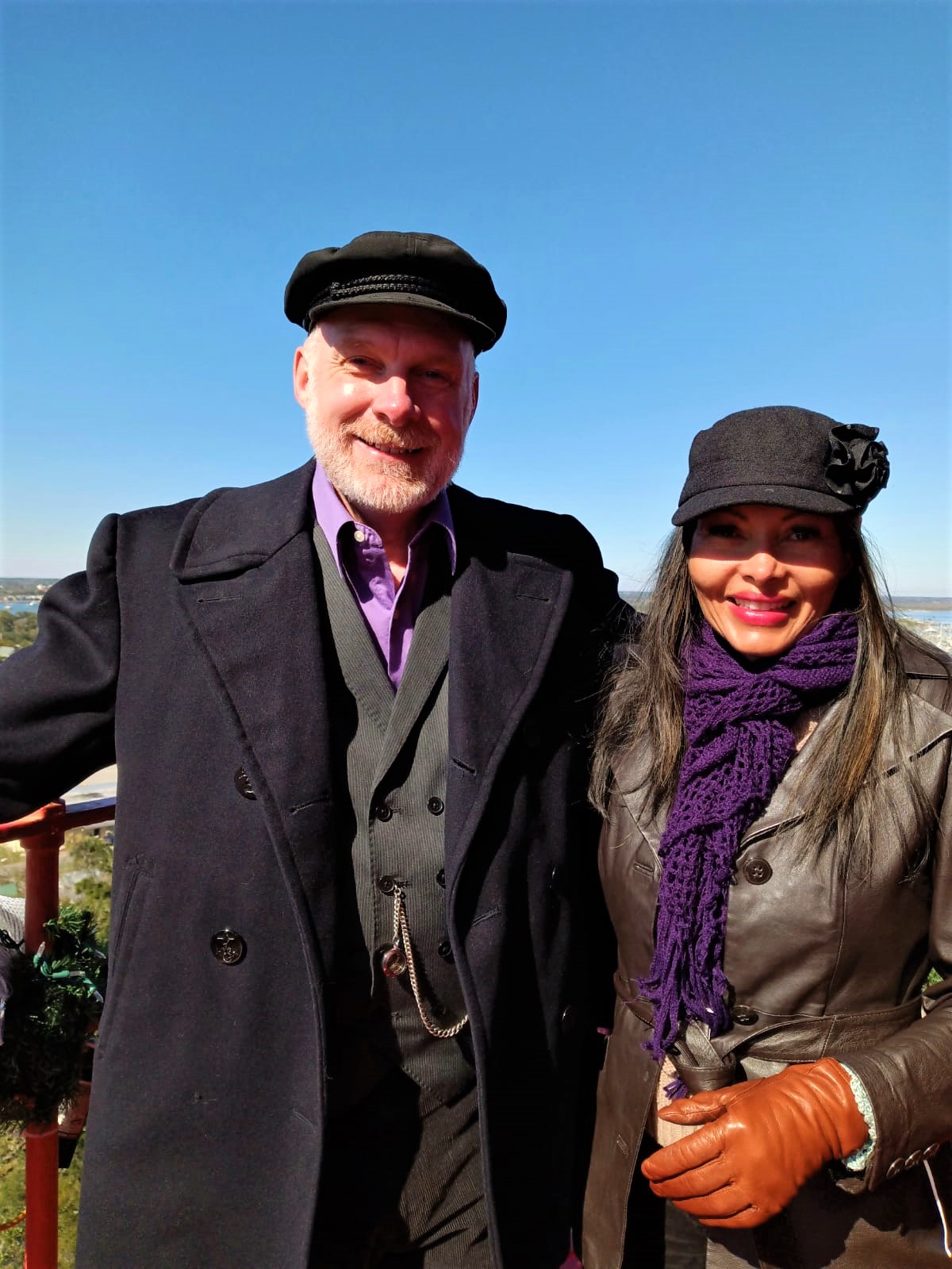

We are here on the lower gallery of the Saint Augustine light. It is mid morning and though the sun brings some warmth, the wind cuts through us in chilled bursts.
Despite the wind, the weather is clear and visibility only hindered by the limitations of the eye.
To one side we can see far out into the Atlantic ocean from this Florida coast. From the other, we look onto the old town section of historic Saint Augustine in the distance with the Flagler College (Former Ponce de Leon Hotel) dominating the skyline its 1885 Spanish Renaissance glory.
The Bridge of Lions is filled with people crossing the Mantanzas River by foot and motorized conveyance.
Construction commence in 1871 and the tower first lit in 1874. This tower was to replace the earlier 18th century Spanish built tower, of coquina stone, which had been undermined by coastal erosion and sadly fell into the Atlantic ocean in 1880.
Today the complex is a museum preserving the 19th century outbuildings, keeper’s house and tower and is open to the public.
As we approach the entrance to the tower, looking towards the galleries atop, we realize how immensely tall this tower is. Though not the tallest in Florida, it is an impressive 165 feet to the top but the lower gallery is at 140 feet. The upper gallery which contains the fresnel lens is not open to the public.
You enter this fully operational tower through the fuel supply and workshop outbuilding.
Once into the tower itself, you are in a voluminous chamber of whitewashed brick with an ornate cast iron spiral staircase.
The staircase is of an open design so you may see through the steps. It hugs the inside wall as it spirals upwards to the lower gallery and from the bottom floor you can look upwards the 140 feet to that lower gallery which is only 219 steps away with an ample number of landings for respite from the climb.
The Senora looked up into the height and sprinted up the staircase like a gazelle. I, SouthernGothic, took it a bit slower as I have never had a head for heights. As I clambered my way up, throngs of people passed me by as I moved aside for them.
How can such a structure hold so many people? I asked myself this and another question answered it. Which was the more powerful force, my fear of heights or my absolute faith in 19th century engineering. All fear dissipated and I fully enjoyed the experience for the first time out of many climbs in this light. The details of construction were suddenly open to my eyes, and the craftsmanship of the structure with attention to aesthetic importance enveloped me as I reached the lower gallery 140 feet up.
Passing through the iron hatchway, I stepped out onto the lower gallery and was met by the beauty of the Saint Augustine area. The Senora was already circling around and caught up with me.
The gallery was filled to capacity with people taking pictures of the landscape below and of themselves. There in the apex of the tower, people trading cell phones to take pictures of each other and politeness prevailed.
Eventually the joy of standing out on the gallery ended and we began the descent. More people passed ascending as we moved aside on the landings. It was a busy day.
We reached the halfway point where the Senora realized she needed a picture of the top landing and she made the ascent again. Waiting on my landing with camera in hand, I watched for a chance to take her picture on the spiral stairs.
As we stepped out into the sunlit yard of the light, there was a feeling of elation from our experience. I wanted to go back atop but others needed their chance. We will return.
The Saint Augustine Lighthouse Museum is a 501C3 organization that relies on donations for its restoration and operation. It is a fully functional light house and the grounds host a museum in the keeper’s house, a maritime archaeology educational program, activities suited for the young, and a WWII exhibit.
As always, be respectful, enjoy the locale and consider joining their membership. https://www.staugustinelighthouse.org/
Until next time. Come, let us stroll with the cat.
