
Items, objects that we use everyday become artifacts after their purpose has been fulfilled. The things may have some great importance in our lives or a temporary one like a bottle which is cast off after its importance is expired.
These artifacts can tell a story about the people who used them, perhaps information long forgotten about lifeways and even individuals we may never know the name of.
The most fundamental concept of archaeology is that the greatest importance is not the thing, but the story and information the thing can reveal. It is the story of human endevour, of us.
This story suffers when an artifact has been removed and turned into a objet d’art. All context, thusly the story lost forever.
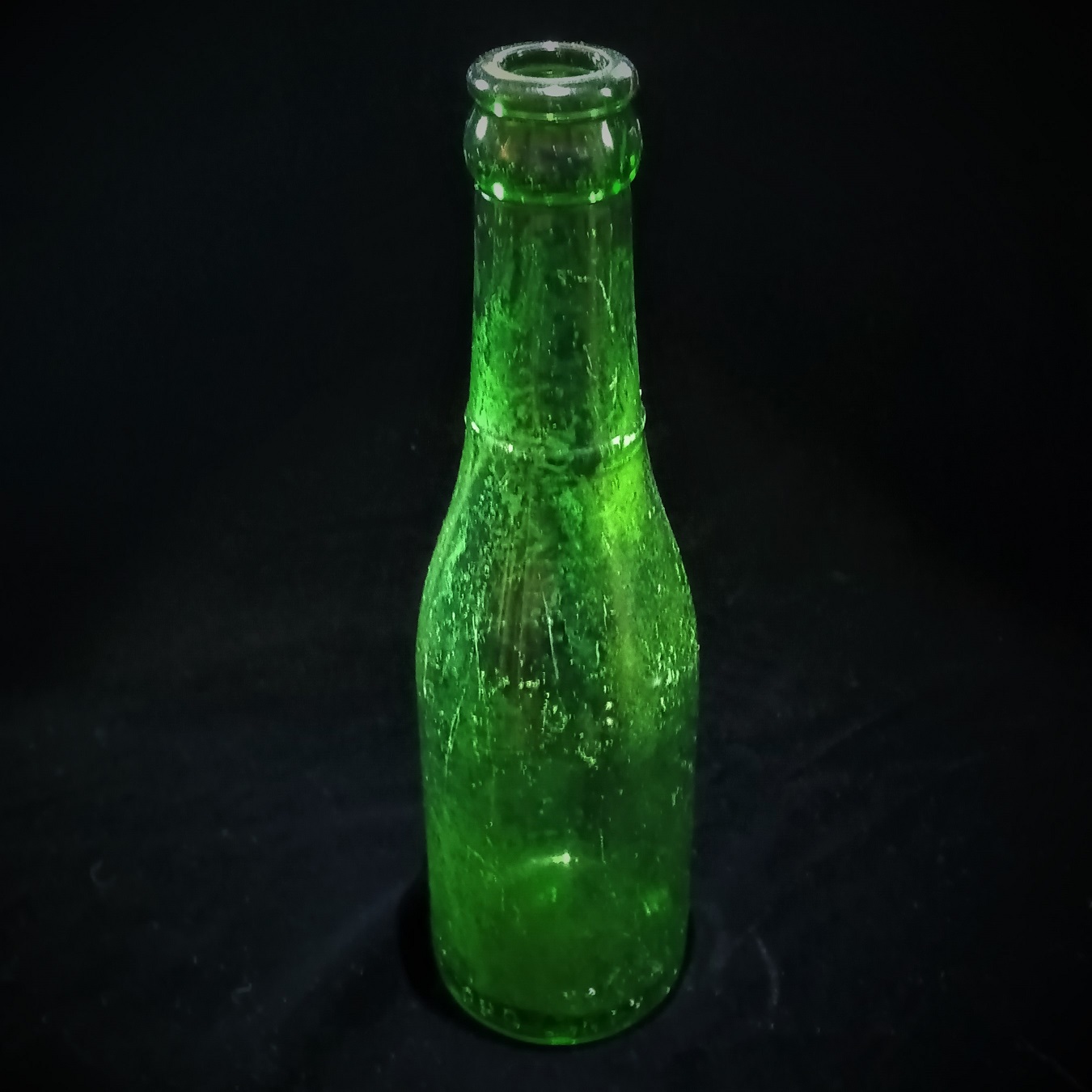
This is the story of a small green bottle.
This bottle I saw peeking out of the soil one afternoon in my front yard. I have identified it as from the Nehi (courtesy the molded imprint) company. They only used this green bottle on two products. Nehi Lemon Sour and Nehi Rum’s Dry Ginger Ale.
The Ginger Ale had an ACL (Applied Color Label) which was baked enamel. The Lemon Sour had a paper label which this one had to be as no trace of enamel is present.
Dating 1928 to late 1930’s, that places this bottle well within the time frame for the construction of my home.
With some continued research, yes it does have the maker’s mark on the bottom and it is the Owens-Illinois Glass Company logo with their Diamond/Oval with an “I” in the middle logo used from 1929 to 1966.
It bears plant code “3” to the left of the logo which designates the Fairmont, West Virginia plant during that time period.
The single digit code to the right of the logo indicates the year from the 1930’s. The later decades are indicated by a double digit code.
This bottle has a “7” designating it as 1937.
Truth in advertising…at least from 1937. The original label stated “At least 6oz in each bottle”, and the lip which is the fill line was there to prove it.
Using a measuring cup with water resulted in 7oz of liquid held at that fill line.
This is all well and good, but any bottle out of context can reveal it’s maker’s history.
What about the context of the find?
A full archaeological survey was undertaken of this property in 2015. A historical survey accompanied the report.
The life of prehistoric peoples to the modern day was covered, including whiskey bottles and metal condom wrappers from the previous owner’s liaisons in the 1950’s. But that’s a story for another time.
By the turn of the century (1900) it was seemingly farmed land.
Evidence of dove hunting appears around the 1915 era. Small gauge shotgun shell ends were found in patterned groupings so that the hunter’s movement could be followed through what was then open field. The paper shotgun shells had brass ends which could still be identified. The brand and model were only made for three years, or so, around 1915.
Twenty years passed ad the field began to be overgrown. A house underwent construction in 1937. This house I sit in now.
Trash piles from the late 1930’s through the 1950’s, dated by product bottles, have been located in several places on the property. They were not part of the archaeological survey but found by myself in my continuing exploration of the property.
This shows that the owners were meticulous in trash disposal. Why is this important?
The green bottle was found by itself with no other items in its vicinity.
It was also near the surface, eroding out of the soil in an area that has little erosional soil loss.
Very likely, this bottle of Nehi Lemon Crush was part of a worker’s lunch during the 1937 construction year. No firm proof of that, of course, but it is likely.
Did this worker refresh himself then toss his bottle into the overgrown brush where it sat for decades barely being covered by earth? Was he by himself or accompanied by fellow workers. Perhaps other similar bottles are somewhere nearby? If they even existed, did they survive as well to tell the story of construction workers lunching?
This bottle survived tree roots, machinery, and the 1964 planting of several hundred camellias. It sat in the ground as time passed by, avoiding decades of mowing machines (33 years of my own mowing), a waterline and tree fall.
In 2015, it managed to elude the archaeological survey.
May of 2022 found me strolling with the cat through the 60 year old camellia plantings when a small green light reflection caught my eye. Carefully I removed the grass and bit of topsoil covering it to find this intact Nehi Lemon Crush bottle.
If I had purchased this bottle off of eBay, or at a flea market, it would be a decorative object with no story to tell.
